martes, 25 de octubre de 2016

Child Labour
The use of working-class children to provide much of the labour force for the Industrial Revolution was merely an expansion and extension of an already long-established practice of working-class children employed by farmers or artisans. The working conditions were highly debated.
On one hand, children worked under deplorable conditions and were being exploited by the industrialists. “Parish apprentice children” were some of the first children to be brought into the factory setting, who had been taken in by the government and placed in orphanages, and were not paid for the work they did; the compensation in basic needs was considered enough and in many cases just barely enough to survive on.
On the other hand, some were looking at the value that came from the labor provided by these children. In many cases these were the factory owners and managers who benefited from the labor. They would argue that the children’s employment was beneficial to “the child, family, and country ".
Industries: Cloth, coal, iron and metal.
.The main industries in England were the cloth, the coal and iron; and the metal industry. All of them were facing difficulties regarding the processes employed for production so it was essential to improve technology at that time. As people strated to buy more goods, textile traders began to look for faster and cheaper ways of producing clothes
To conclude, the first part of the eighteenth century was a period in which people began to realize that there was a need for a change so as to improve the production in the different industries. Several inventors worked really hard to develop new methods and machines that would optimize and facilitate the production. These inventions had a profound effect on England’s invention and they marked the process of industrialization which had already begun and turned England into the leading industrial nation of the period.
The greatest innovation for the difficulties in cloth production was the invention of a the spinning wheel. In 1764, the Spinning Jenny was invented by James Hargreaves, which he patented in 1770. It was the first practical spinning frame with multiple spindles. The jenny worked by first clamping down on the fibres, and then by drawing them out, followed by twisting.
In the other two great English industries, coal and iron, there was an equal need for technological improvement. Because of the rise of industrialization, there was an incredible demand for coal and iron. People used to find iron and coal and they deliberately uprooted them, but then the task turn almost impossible since they had to go deeper. The invention that solved this problem was the steam pump developed by Savery and Newcomen, which was then perfected in 1712.
Finally, the most vital of English industries was the metal trade. Up to that moment, iron had always been smelted by charcoal, but all the forests were being destroyed. The metal industry seemed to be in a period of crisis and many people were trying to discover new ways of smelting coal. Fortunately, the Darbys of Coalbrookdale discovered that they could use coke for smelting instead of charcoal.Thanks to this process, England started to lead the world in the industrial revolution.
jueves, 6 de octubre de 2016
Riots: The Riot Act
Particularly in London, mini-riots took place on almost every public occasion; like elections, fairs, and executions; where the poor caused window-smashing and looting. The Riot Act aimed to prevent this kind of tumults and riotous assemblies in a time of wide spread social disturbance, giving them an hour to disperse.
The most important riots that preceded the Riot Act were The Sacheverell Riots in 1710 and the Coronation Riots in 1714, both against George I’s government. Passed by British Parliament in 1714, the Act enabled local enforcement to approach a group of a dozen or more people that showed signs of being unlawfully and tumultuously assembled. Not only the Act had to be read out loud to take effect, but also the rioters took it as a provocation and that made the riot and chaos to spread.
Therefore, the riots continued throughout 1715, where the mobs, that consisted mostly of Tories, set Dissenting Chapels on fire while they chanted ‘No Hanoverian, No Presbyterian Government’. The government arrested the leading Tories to prevent them to rise thanks to the Riot Act.
Although the Riot Act was practiced until 1919 and did prevent the Jacobite Rising in 1715, it was unsuccessful at controlling disturbances because of its impracticality: at times, it was unclear if the Riot Act had actually been read .As to the use of force, rioters often believed that the military could not use force until one hour had passed since the reading of the proclamation. In spite of its impracticality many jurisdictions that have inherited the tradition to this day, and the expression "to read the Riot Act" remains in common use in the English language.
The most important riots that preceded the Riot Act were The Sacheverell Riots in 1710 and the Coronation Riots in 1714, both against George I’s government. Passed by British Parliament in 1714, the Act enabled local enforcement to approach a group of a dozen or more people that showed signs of being unlawfully and tumultuously assembled. Not only the Act had to be read out loud to take effect, but also the rioters took it as a provocation and that made the riot and chaos to spread.
Therefore, the riots continued throughout 1715, where the mobs, that consisted mostly of Tories, set Dissenting Chapels on fire while they chanted ‘No Hanoverian, No Presbyterian Government’. The government arrested the leading Tories to prevent them to rise thanks to the Riot Act.
Although the Riot Act was practiced until 1919 and did prevent the Jacobite Rising in 1715, it was unsuccessful at controlling disturbances because of its impracticality: at times, it was unclear if the Riot Act had actually been read .As to the use of force, rioters often believed that the military could not use force until one hour had passed since the reading of the proclamation. In spite of its impracticality many jurisdictions that have inherited the tradition to this day, and the expression "to read the Riot Act" remains in common use in the English language.
The consequences of the Napoleonic Wars.
Emperor of France with a limitless ambition and considered one of the greatest commanders in history, Napoleon Bonaparte wanted to create a wide empire trough all Europe ruled autocratically by a dynasty founded by him. Among many, the long lasting effects of the Napoleonic Wars were caused by the ideology of nationalism.
As Napoleon expanded the French Empire, he took over many countries and led them to find an overpowering sense of nationalism that spreaded throughout Europe, and countries created their own idea of what a citizen was, specially Germany, that created strict citizenship laws, those being a key cause to the World Wars.
Many treaties that Napoleon attempted to create caused later effects. The treaty between France and Austria signed during Napoleon's reign later affected the Treaty of Versailles. After he got taken out of power, and the countries he had taken over got their freedom back, those countries didn't want to let other people into their countries. Tensions began to build, and exploded when Franz Ferdinand, Duke of Austria, was assassinated by a Serbian rebel, causing World War One.
Overall, both World Wars were essentially caused by Napoleon's reign and the events that took place after he died. The events that took place during twentieth century Europe were the biggest effects of Napoleon's reign. The nationalism that Napoleon caused can be seen in the Nazis rise to power. These events made the world as it is now, and without Napoleon, none of these things would have been set into motion.
As Napoleon expanded the French Empire, he took over many countries and led them to find an overpowering sense of nationalism that spreaded throughout Europe, and countries created their own idea of what a citizen was, specially Germany, that created strict citizenship laws, those being a key cause to the World Wars.
Many treaties that Napoleon attempted to create caused later effects. The treaty between France and Austria signed during Napoleon's reign later affected the Treaty of Versailles. After he got taken out of power, and the countries he had taken over got their freedom back, those countries didn't want to let other people into their countries. Tensions began to build, and exploded when Franz Ferdinand, Duke of Austria, was assassinated by a Serbian rebel, causing World War One.
Overall, both World Wars were essentially caused by Napoleon's reign and the events that took place after he died. The events that took place during twentieth century Europe were the biggest effects of Napoleon's reign. The nationalism that Napoleon caused can be seen in the Nazis rise to power. These events made the world as it is now, and without Napoleon, none of these things would have been set into motion.
viernes, 26 de agosto de 2016

martes, 19 de julio de 2016
AMERICAN REVOLUTION
The Seven Year's War led Britain in a fragile condition that led to even more issues, the greatest being the American Revolution.
On the Economic aspect, thanks to The Navigation Acts, colonies were forbidden to trade directly,and were forced to use Britain as an intermediate to re-export. Nevertheless, this also provided the colonies a steady market and the protection of the British fleet.
On the political aspect, The colonists obtained land illegally from Native Americans, which led Britain to build a larger army to defend the colonists from the Native Americans and the French, so they thought that Colonists should at least contribute paying one third of the costs.
On the financial side,the Parliament had the right to pass the Stamp Act, imposing his taxation on the colonies as a contribution to the Army. But colonists thought that they could not be taxed internally by a Parliament in which they weren't represented.
Colonists answered to The Townshend Act of 1767 with revolts, being the most important ones "The Boston massacre" in which soldiers prevented an uprising, and the "Tea into the Sea"(1778) that helped colonists to reduced the duty on tea,orchestrated by The Sons Of Liberty.
Among the effects of the American revolution, The Articles of Confederation,though insufficient, were the first attempts to govern a nation.The Constitutional Convention consisted in overcoming the previous one to eliminate the formation of a new government.
The Federalists Papers (based on essays by Hamilton, Jay and Madison), outlined the reasons why the States should ratify a Constitution.
The Bill Of Rights, the first ten amendments to the united States, and of course, The Declaration of Independence being the most important effects, the revolution ended with the Treaty of Paris in 1783 in which Britain surrendered, but setting the path to the French to begin their own.
lunes, 18 de julio de 2016
THE MADNESS OF KING GEORGE
George III's increasing dementia, his rivalry with his own son,people blaming him for losing the American colonies,and the opposition led by Charles James Fox mark the unstable and unpopular path of George III's reign. But not everyone wanted to overthrow him.
Queen Charlotte and The PM William Pitt brought doctors to treat King George, but with no results, due to the primitive medical practises of that time,until they find an unconventional doctor with a technique similar to modern psychiatry. Though George slowly recovers, there was not an exact diagnosis at the time. A modern diagnosis is that George III suffered porphyria, which symptoms are severe abdominal pain, vomiting, neuropathy, and mental disturbances.
Queen Charlotte and The PM William Pitt brought doctors to treat King George, but with no results, due to the primitive medical practises of that time,until they find an unconventional doctor with a technique similar to modern psychiatry. Though George slowly recovers, there was not an exact diagnosis at the time. A modern diagnosis is that George III suffered porphyria, which symptoms are severe abdominal pain, vomiting, neuropathy, and mental disturbances.
domingo, 12 de junio de 2016
Wesley's influence on British society
Not a systematic theologist, John Wesley was a great social reformer that not only played a leading role in the Holiness movement and religion but also prevented Britain from a revolution. An Anglican clergyman, Wesley used a controversial and unconventional practice called field-preaching, that consisted in going to unusual places to preach, to the open air, expanding the word of god outside the church, and there so, reaching factory laborers and newly urbanized masses.Due to his preaching circuits ( also called “Methodist connections”), conferences and an interlocking system of societies, Wesley’s influence throughout England was extended, a consequence of how a remarkable organizer he was.
Following a younger colleague, George Whitefield, that began preaching in the open to coal miners in Bristol,Wesley did his first field-preaching to nearly three thousand people. Whitefield’s influence converted Wesley into an evangelist that focus on conveying salvation and holiness to the un-churched.
Concerned for people's physical as well as spiritual welfare and believing that doing good to others was evidence of inner conviction, he spent most of his money on charity, caring for the sick and supervising orphanages and schools. He not only wanted individuals to be holy, but also society in a whole. Not only had his movement given opportunities for the underclass, but also for women, appointing them to lay preaching in the rise of Methodism, which was open to all who were sincere seekers after salvation, and not only limited by members of the Church of England.
In an era when literacy was restricted to the elite,bringing spiritual hope to the masses was considered dangerous by the Establishment,that, frightened by the emotionalism that Wesley’s preaching caused in the underclass, regarded Wesley as a traitor for his class. Methodist meetings were frequently disrupted by mobs, encouraged by local clergy and magistrates. Methodist preachers were harassed until the 1760s. Wesley consistently stated that he had no intention of separating Methodism from the Church of England. However, it was forced to. Firstly, by circumstances in America, and secondly, four years after Wesley's death, with the Plan of Pacification which formulated measures for the now independent church, now with a Conference of one hundred people, named by Wesley, now in charge.
Helping the poor, Wesley himself died poor, but leaving a vast legacy, being the most important the Methodist Church, consisting now with a worldwide membership of approximately 75 million people. Considered a pioneer of modern revivalism,which continues to be a potent force of Christian renewal worldwide, and the father of the Holiness Movement and Pentecostalism; Wesley led direction in many social justice issues of the day, like prison reform and abolitionist movements, that provided hope and encouraged discipline among Britain's newly urbanized and industrialized working class; making the evangelical revival that enabled Britain to avoid the political revolutions that unsettled France and the European continent. As he said it, “Methodism was the antidote to Jacobinism”.
sábado, 28 de mayo de 2016
viernes, 20 de mayo de 2016
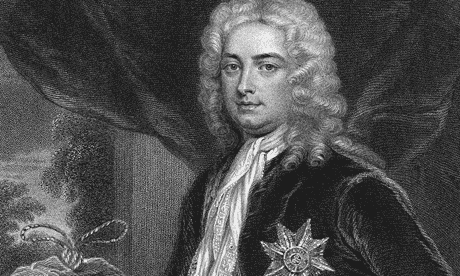
Walpole: Britain´s Financial Saviour
Walpole, not inspiring, but a great financer, saved Britain from a deep hole and made it catch a breath between wars.
The South Sea company started bribing members of Parliament to become the sole creditor of the National Debt, to achieve a reputation of a trustworthy company. After they took over the National Debt, a frenzy for buying shares in the Company started. But the bubble burst when the shares fell as abruptly as they have risen, and people started getting rid of them after realizing the shares could not be worth their value. And trust for Government fell with them, leaving the space open for Walpole to take over.
A cunning and resourceful Eton graduate, and named First Lord of the Treasury, he send to confiscate the assets of South Sea Company directors and distributed them to bankrupt shareholders, dividing the stock between the East India Company and the Bank of England, and abolished duties to improve tariffs. He tried to shift the tax burden from landowners to merchants, and to introduce duties on wine, tobacco and other ‘non-essential’ goods, not in port, but when they were taken out of the warehouses for internal commerce. The Excise Bill, as it was called, was made to prevent smuggling and to allow goods to be re-exported without paying any duty. This was dismissed after a wave of fury against it, not only from Walpole´s known oppositors, like Pitt, Bolingbroke and the Tories, but from the whole country.
In 1722,Walpole solidified his position as Prime Minister using the uncovered Jacobite conspiracy called Atterbury plot to advantage, branding all Tories and Jacobites, keeping the Tories out of office until 1770. Afterwards,he was considered the most influential politician in England .
After being forced into war with Spain in 1739, his hold on the House of Commons decreased. Mostly, because of the attacks from the Opposition led by William Pitt, who spoke in favour of an inquiry against Walpole accusing him of bribery and corruption, besides all his criticism about his support of the status quo and propensity for doing little.
Walpole resigned in 1742 due to failing health, but he was succeeded as Prime Minister not by Pitt, but for Lord Wilmington, a government that Walpole carefully orchestrated as a continuation of his own, and served in the House of Lords till his death in 1745, leaving Pitt unable to take any personal gain from Walpole’s downfall.
Remembered little for his inspiration,legislation or leadership and leaving the administration of foreign affairs to others, Walpole had a policy of peace ( of course, there was just enough money to keep the country going, let alone the big spending a war meant) that helped Britain to later endure during the next wars, and made the Hanoverian dynasty secure, after surviving England’s first stock-market crash.
viernes, 6 de mayo de 2016
viernes, 22 de abril de 2016

viernes, 8 de abril de 2016
viernes, 1 de abril de 2016
REASONS AND RESULTS OF THE GLORIOUS REVOLUTION (1688)
Reasons
England was an unstable
place riven with religious conflicts between Catholics and Protestants. Conflicts
between the Protestant Parliament and the increasingly Catholic monarchs began
to grow. King James II was trying to allow religious freedom with his
proclamations known as the Declaration Of Indulgence, just to appoint Roman Catholics
to important positions in Parliament. With the arrival of his new son implying
a new Roman Catholic Monarch being a threat to the Parliament, they invited William
Of Orange, a Protestant, and his wife, Mary, to go to England to take the
throne. James II was defeated by William in the Battle of the Boyne.

Painting of the Battle of the Boyne, by Jan van Huchtenburg
Results
The Bill Of Rights, allowed William III and Mary II to take the throne in exchange
for giving more power to the Parliament, and also stated that, from that moment
onwards, no Monarch could be Roman Catholic or raise taxes without
parliamentary consent..This caused a Cabinet Government, that also signed The
Toleration Act, that allowed freedom of worship to Noncomformiss and Protestants,
purposely leaving behind Catholics, Nontrinitarians and atheists.

Mary II and William III, painter unknown.
Suscribirse a:
Entradas (Atom)